How to Read a Cross Stitch Pattern
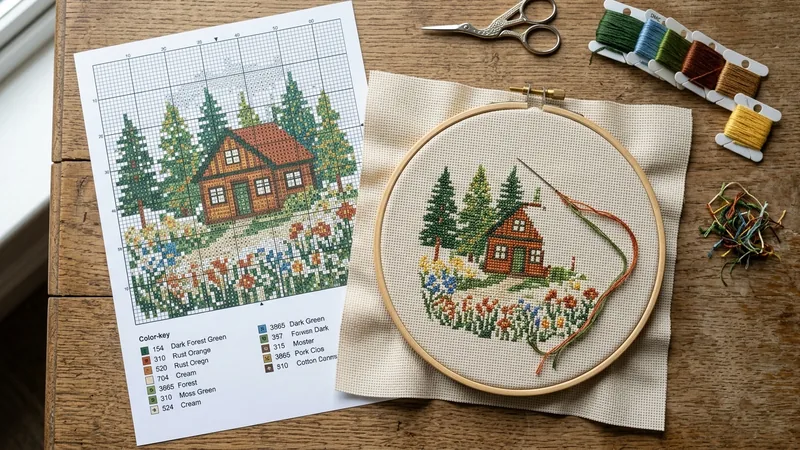
This guide explains every part of a cross stitch pattern (also called a chart): the squares, the symbols, the key, the grid lines and the thread list. The short version: each square on the chart is one stitch on your fabric, and the symbol in the square tells you which color to use. The examples use the free patterns on this site, but the same rules work for almost any chart.
One square = one stitch
Each square on the chart is one X stitch on one square of fabric.
- A pattern of 129 x 166 stitches is 129 X’s wide and 166 tall. The Red Fox Holding a Maple Leaf is this size.
- A blank square means no stitch. The fabric shows through there.
To find the finished size, divide the stitches by the fabric count:
| Fabric | Red Fox (129 x 166 stitches) |
|---|---|
| 14-count | 9.2“ x 11.9“ |
| 18-count | 7.2“ x 9.2“ |
The chart stays the same; only the fabric changes the size. Every PDF on this site lists the finished size for 11-, 14-, 16-, 18- and 28-count, so you don’t have to work it out.
Symbols and the key
Every thread color has its own symbol. The key (or legend) tells you which symbol is which color. For each one it shows:
- the symbol
- the DMC thread number (DMC is the most common embroidery thread brand; “DMC 310” is always the same black)
- the color name
On the charts here:
- The symbols are simple shapes. There are no letters or numbers, so they can’t be confused with the grid numbers.
- The symbols are different in every pattern. A star in one pattern is not the same color as a star in another. Always check the key of the pattern you’re stitching.
- Each chart page shows the key for the colors on that page, so you don’t have to turn pages.
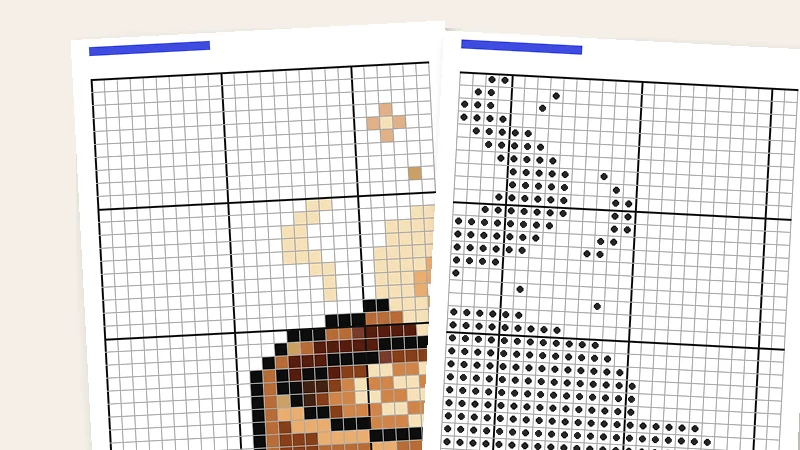
Color or black and white: in a color chart, each square is filled with its thread color and the symbol is on top. In a black-and-white chart, only the symbol is printed. Always follow the symbol. Two similar shades can look the same on paper, but their symbols are always different.
Finding your place
| Chart feature | What it’s for |
|---|---|
| Bold line every 10 squares | Count in tens from the nearest bold line, not square by square from the edge. |
| Arrows on the edges | They point to the center column and center row. Start stitching there. |
| Page header (big charts) | Tells you which part of the pattern the page shows, for example “Grid Page 3 of 9 · Cols 44–86 · Rows 1–56”. |
| Small map on each page | Shows the whole design with this page’s section highlighted. |
| Overview page | The whole design on one page, to see how the pages fit together. |
To start in the center: fold your fabric in half both ways. Where the folds cross is the center. Match it to where the chart’s arrows meet.
Half stitches and backstitch (on other charts)
Some designers use extra stitch types:
- A square split diagonally, or a small symbol in one corner, usually means a half or quarter stitch.
- Lines drawn over the grid (not inside squares) are backstitch, a straight outline stitch added at the end.
Charts that use them include a note explaining the marks. Every pattern on this site uses full cross stitches only. If a square has a symbol, it gets a full X.
The thread list
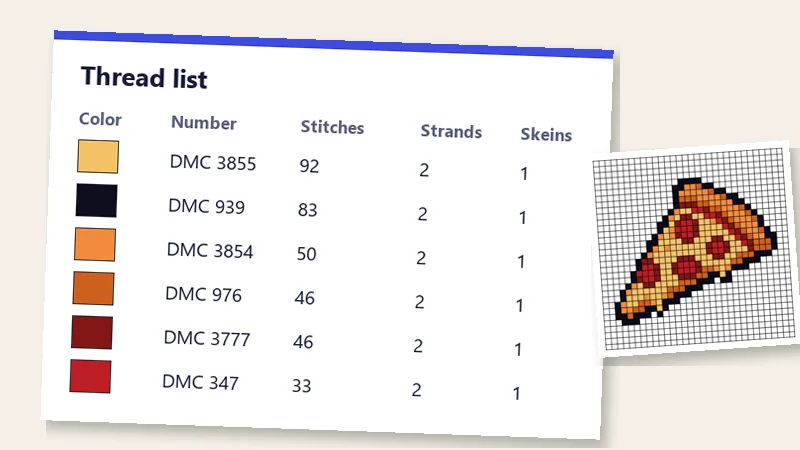
The last page of each PDF is the thread list. It’s your shopping list. For every color it shows:
- symbol
- DMC number and color name
- strands to stitch with (2 for every pattern here)
- how many stitches use that color
- how many skeins (packs of thread) to buy
Two things to check before you shop:
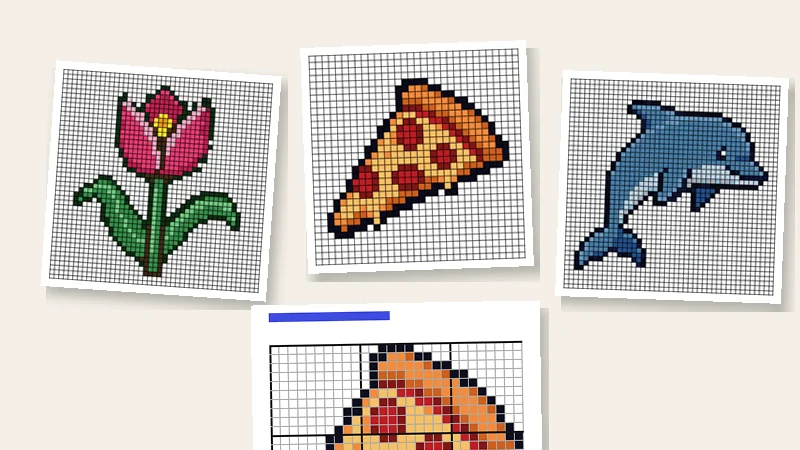
- Which color is used most. On the Leaping Dolphin, one blue (DMC 518) is 317 of the 642 stitches. Make sure you have enough of that one.
- Small charts need one skein per color. The Pizza Slice has only 350 stitches but 6 colors, so it needs 6 skeins. You’ll have thread left over for the next project.
For how many skeins and strands to buy, and how to sort your thread, see the cross stitch thread guide.
Questions
Where do I start stitching? In the center. Find it with the arrows on the chart and by folding your fabric in half both ways.
What does an empty square mean? No stitch there. The fabric shows through.
Why are the symbols shapes and not letters? So they can’t be confused with the row and column numbers.
How do I practice reading a chart? Print one page. Find the center arrows. Pick a square on a bold line, count 10 across and 10 down, and check that symbol in the key. Then start with the Pizza Slice. When that feels easy, The Wee Celtic Druid is a good test of careful counting.
What should I read next? How to cross stitch for beginners explains the stitch step by step. How to print a cross stitch pattern shows the print settings that make symbols easy to read.
Join us on Facebook
New free patterns every week, stitching tips, and a place to share what you've made.